How to write action titles: what 1,155 real slide titles show
An action title states what the slide proves in one sentence, within two lines. Of 1,155 firm slide titles, 67% do it, and half of those pass 15 words.
An action title is one full sentence that states what the slide proves, so a reader could disagree with it. To write one, finish the line “This slide shows that”, cut those words, and keep the result within two lines. Move any second point to the chart header or a callout.
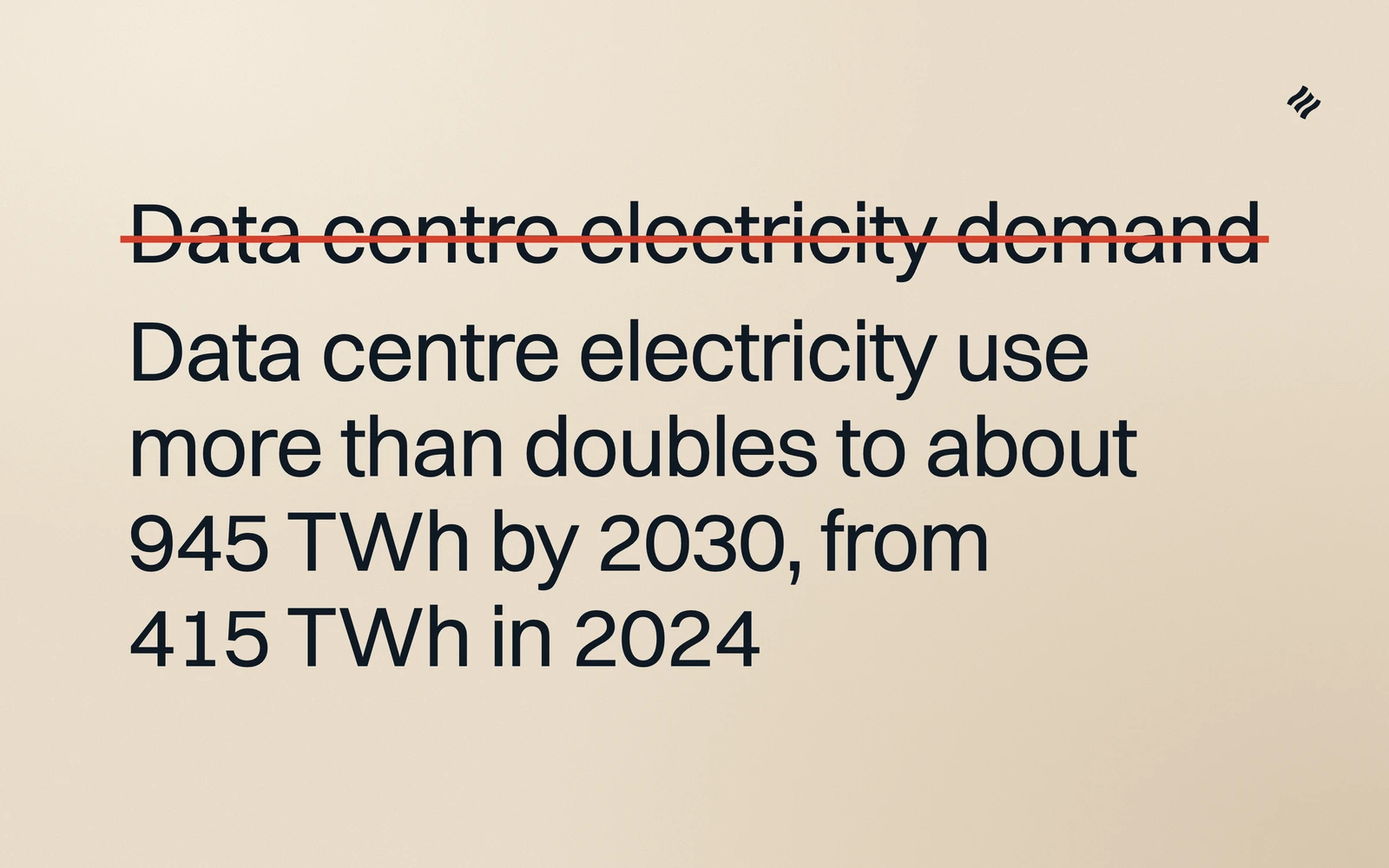
Data centre electricity demand is a label. Data centre electricity use more than doubles to about 945 TWh by 2030, from 415 TWh in 2024 is an action title on the same chart (IEA figures).
Decky AI, which makes a PowerPoint agent and publishes this blog, counted 1,155 slide titles from 48 public English-language McKinsey, BCG and Bain decks on 3 November 2026. About two in three (67.1%) are action titles and about one in five is a plain label. Half of the action titles run past 15 words, 95.5% fit in two lines, and almost none ends in a full stop.
If a manager has written “so what?” in the margin and the deck is due, go straight to the rewrites for awkward slides. Anyone citing the count should read the method and its limits.
What do real slide titles do? Two rules hold and five do not
Slide titles in 48 public McKinsey, BCG and Bain decks follow two of the rules you will hear: write a sentence with a claim, and stay within two lines. They break the other five, on word count, numbers, verbs, full stops and an action title on every slide.
| The rule as you may hear it | What the 48 decks do | Does it hold? |
|---|---|---|
| Write a full sentence with a claim | 67.1% of titles do, and another 8.6% make a claim with no verb | Yes |
| Stay within two lines | 95.5% of action titles do, and 75.8% take exactly two | Yes |
| Put an action title on every slide | 18.4% of titles are plain labels, and the median deck has 73.3% action titles | No |
| Stay under 15 words | 49.3% of action titles run past 15 words | No |
| Put a number in the title | 26.7% of action titles carry a digit | No |
| End on a full stop | 2.1% of action titles do, in 3 of the 48 decks | No |
| Avoid weak verbs such as is and are | Is and are are the commonest verbs, and a form of to be appears in 33.6% of action titles | No |
These are mostly public reports and talks rather than internal client work, and a count says what is common while leaving open what works. The nearest evidence on effect is a 2011 study by Garner, Alley and colleagues: two student audiences heard the same recorded talk, 55 with topic-subtopic slides and 56 with sentence headings, and the second group scored higher on complex concepts, some differences statistically significant. It was a technical talk and Alley has long advocated the approach, so take it as a pointer for business decks.
How long should an action title be? Two lines, often more than 15 words
An action title should fit in two lines at your template’s title size, and the word count follows from that. Across 763 action titles in public McKinsey, BCG and Bain decks the median is 15 words, the middle 80% run from 9 to 22 words, and 49.3% pass 15, while 95.5% fit in two lines. The 15-word cap is stricter than these decks, and the two-line limit describes them well.
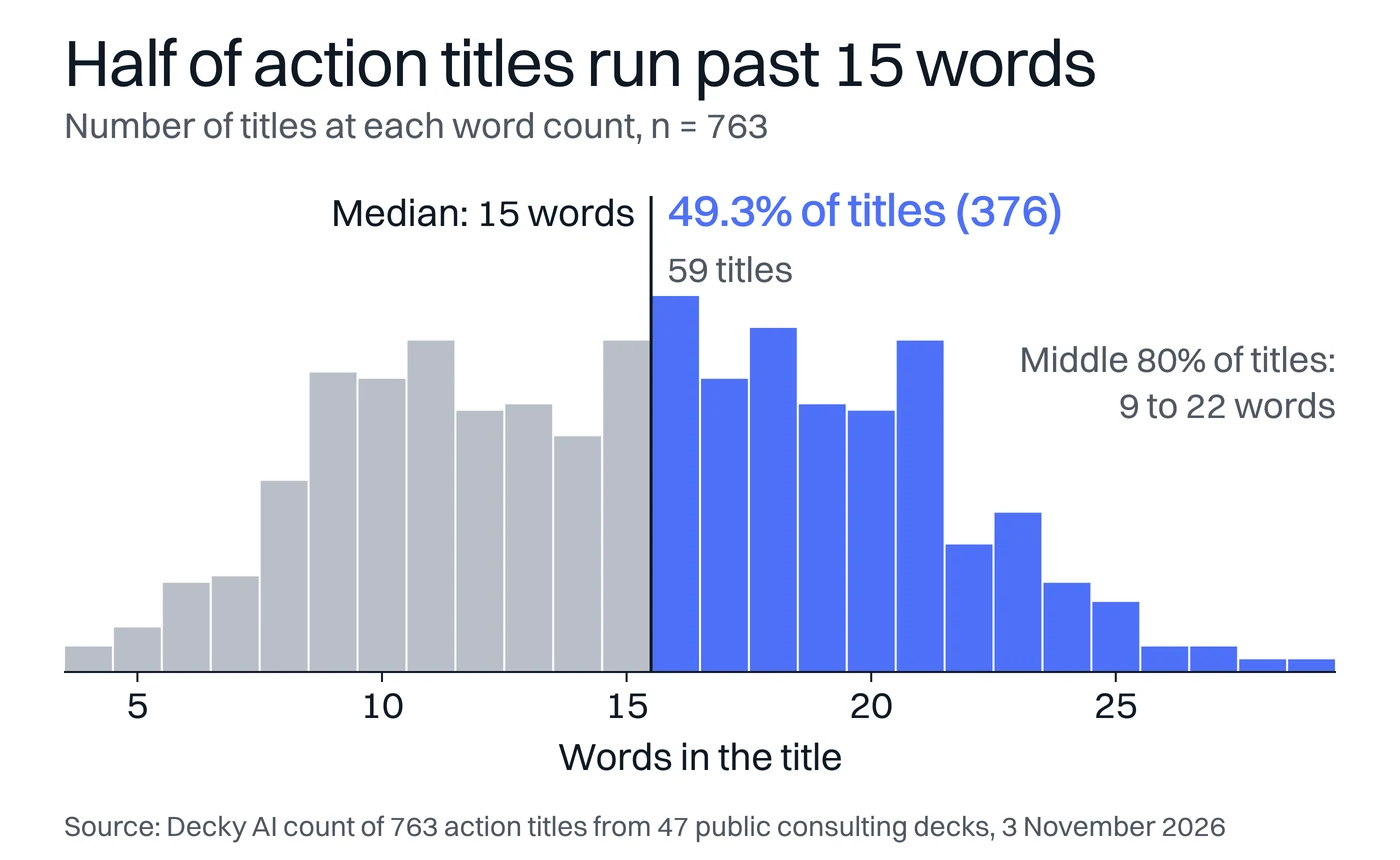
Two lines depend on the template, since a larger title size holds fewer words, so test the limit on your own master. In these decks the median title is 24 pt over 12 pt body text, and 98.7% of action titles are in sentence case.
Past 20 words, look for a second point. 17.6% of action titles run that long. By a rough text match, a second part such as a colon, a dash, but or while appears in 57.3% of the longest titles (22 words or more) and in 35.3% of all action titles, so a second part is normal in itself. Ask whether the reader needs it to take the point. If it is a qualifier, a method note or a second finding, move it to the chart header or a callout.
Does an action title need a verb, a number or a full stop?
An action title usually needs a verb, it needs a number only when the number is the point, and a full stop is a house style choice.
Does an action title need a verb?
Usually yes. In the count of 1,155 titles, 67.1% are sentences with a claim and 8.6% make a claim with no verb, headline style. Ask whether a reader could disagree: if nobody could, it is a label. Read a verbless title aloud, and if it needs a verb to make sense, add one.
Plain verbs are normal: is and are are the commonest. About one action title in eleven (8.7%) uses can, could, may or might, which is the honest form when the evidence is still soft. Bain & Company and IVCA’s “PhonePe ($850 million) and Lenskart ($600 million) were the largest deals” (India Venture Capital Report 2024, page 17) makes its claim with a plain were.
Should every action title carry a number?
Use a number when the number is the point. About three in four action titles carry no digit, and only 11.5% carry a figure with a unit. In BCG and Altagamma’s “3 channels dominate True-Luxury online ecosystem, counting for ~90%” (True-Luxury Global Consumer Insight 2018, PDF page 25), the number is the finding. When a title does carry a figure, the reader should find it on the slide.
Should an action title end with a full stop?
Treat it as house style: pick one form and keep it through the deck. 2.1% of action titles end in a full stop, and only 3 of the 48 decks have any.
Can an action title be a question?
It can, on a stage. 1.4% of titles are questions, rising to 4.1% in talks, where a speaker answers out loud. A deck read alone is different, because the reader wants the answer in the title.
What should an action title say on a chart, a table or a roadmap?
It should name the one thing the exhibit settles: the change on a chart, the comparison on a table, the trade-off in a recommendation, the dependency on a roadmap. Where no finding exists yet, write the hypothesis and mark it.
Chart: name what changed and by how much
- Label: Data centre electricity demand
- Action title: Data centre electricity use more than doubles to about 945 TWh by 2030, from 415 TWh in 2024
The IEA’s Energy and AI report gives the figures. The chart header keeps the unit and the scope, “TWh, world”, and the title keeps the change. The title fixes what the page must prove and leaves the exhibit open, as one action title built three ways shows.
Table: say what the rows add up to
- Label: AI use by enterprise size, EU, 2025
- Action title: Large EU firms use AI more than three times as often as small ones: 55% against 17%
Eurostat’s 2025 figures count small firms as 10 to 49 employees and self-employed persons, and large firms as 250 or more. Naming the exhibit is the commonest miss: by a rough keyword grouping, 55.9% of the 213 plain labels in the count do only that. Ask what comparison the reader should take from the rows, and write that.
Recommendation: state the action, the gain and the trade-off
- Label: Recommendation: depot network
- Action title, fictional freight company: Close the Hamburg depot by Q3: it saves EUR 4.2M a year and slows 6% of deliveries by one day
The trade-off is what a partner will ask about, so it belongs in the title. Opening on the verb is fine: 2.4% of action titles in the count do it, and 9.5% in decks prepared for a named client or public body.
Roadmap or process: put the dependency in the title
- Label: Implementation roadmap
- Action title, fictional ERP rollout: Three phases put the new ERP live by March, and phase two cannot start until the data clean-up ends
A process page rarely has a finding, yet it nearly always has one date or one dependency the reader must not miss. The roadmap in the market entry guide puts its gates in the title the same way.
No finding yet: write the hypothesis and mark it
- Label: Overtime analysis (work in progress)
- Action title, fictional warehouse operator: Hypothesis: night-shift rostering drives more warehouse overtime than order volume does
Add a small “to be confirmed” marker on the slide. “The pyramid is a tool to help you find out what you think”, says Barbara Minto, author of The Pyramid Principle (McKinsey alumni profile), and a draft title does the same job. Plainly marked, it can turn out wrong and still tell the team what data to get. Replace it when the numbers land.
Over-long title: keep the finding and move the rest
- Before, 34 words: Based on our analysis of 14 months of order data across all five regions, we believe that late deliveries are largely driven by the two inland depots, which account for most of the delay
- After, 8 words, fictional logistics company: Two inland depots cause 60% of late deliveries
The method moves to the chart header, “Late orders by depot, last 14 months, five regions”, “we believe” goes altogether, and “most of the delay” becomes the figure.
Glossary, method or case page: keep the label
A page that does not argue can keep a label such as Glossary, Methodology or Next steps. By a rough grouping, about 44% of the labels in the count sit on summary, reference, case or section pages where a label is defensible. The rest name an exhibit or framework, and those are the ones to rewrite.
Keep each label distinct. 19.7% of labels repeat within their deck, against 4.1% of action titles, and Microsoft asks for a unique title on each slide. If a slide needs a signpost such as a section name, put it beside the sentence: about 38% of titles sit with a tracker, a small label above or a tag.
How do you check every title in PowerPoint?
Click View, then Outline View, and read only the titles in order: they should make the argument on their own. Where the argument jumps, a slide is missing. Where two titles say the same thing, one slide can go.
Outline view also exposes a fault the slide itself hides: a line that looks like a title may not be the slide’s title. Microsoft says a slide without a title “will have no text to the right of the slide number” in that view. So if a slide shows a heading and nothing sits beside its number, type the heading in the layout’s title placeholder.
Then select Review, Check Accessibility, the pane Microsoft points to for finding missing or duplicate titles. Its ribbon also offers Set as Slide Title, which “makes the selected object your slide title”, so a text box you already have can become the title.
How were the 1,155 titles counted, and can you cite them?
Decky AI, the maker of a slide product with no affiliation to the three firms, made this count on 3 November 2026, by extracting titles from public PDFs and having an AI model classify them against a written definition. You are welcome to cite the aggregate figures, attributed to Decky AI with that date. Corrections and method questions go to hello@decky-ai.com.
Corpus. 62 public PDFs attributed to McKinsey, BCG or Bain by third-party lists of real presentations, created in 2018 or later, with a page ratio of at least 1.6, which keeps widescreen decks (47 of the 48 counted are 16:9). Three refuse text extraction and were left out, and across the other 59, filters for first and last pages, blank pages, pages under 30 words, pages with no title found, and agenda or legal pages left 1,510 slides. Setting aside other languages, three recruiting decks and 12 strings that were not titles leaves 1,155 titles, in 23 McKinsey, 12 BCG and 13 Bain decks.
Definition. An action title makes a claim a reader could disagree with, normally with a finite verb. A topic label names a subject. A descriptive sentence says what the slide shows, with no claim (4.5% of titles).
Extraction and classification. Titles came from the PDF text and font sizes, normalised to a slide 540 points tall. An AI model compared 90 rendered pages with the extracted titles and found 4 errors. Of the 775 action titles, word, digit and punctuation counts use the 763 with clean text, from 47 decks because one deck has no action titles, and line counts use 730 of those, leaving out 33 narrow side-panel titles. Digit counts skip list numbers, part marks and period labels. Second parts, label types and signposts come from rough text and layout rules. An AI model read each title once against the written definition, and a separate rule-based classifier agreed with it on sentence, label or question for 88.9% of 1,220 English titles (kappa 0.749).
Limits. These are mostly public reports and talks, released by choice, rather than internal client work, and they are what public links provided, so they are no random sample. Some real slides were dropped, such as charts drawn as pictures: adding back the 84 found among 215 dropped pages gives 65.2% action titles and 19.9% labels, hence “about two in three”. The count describes a genre and cannot show that any form of title works better. An earlier count on this blog gives a median title of 11 words, from a cruder extractor across every language and class of title. Across all 1,155 titles here the median is 13.
Decky AI writes titles as findings, in the file you have open
In the PowerPoint add-in, set your working style to Consultant or Corporate strategy and titles come out as sentences that state the finding. The same guidance asks for one idea per slide and for charts with an action title and a source. Your style guide wins over this default, so a house rule on length or signposts stays in charge.
Reading the titles in order is where Decky begins. It works storyline first, drafting the argument and the governing thought per section before it builds a page. It can propose the slide titles as a list you edit before it builds, and if you ask for a ghost deck you get empty slide frames with the action title under each, so the argument reads straight through before a chart exists. On a finished deck, ask Decky to list the slide titles and read them in order.
When it fills a template deck it writes one action title per content slide, so that the titles read in order make one argument, and keeps cover, agenda, divider and closing titles as short labels. It shows the planned titles first, and you can edit and reorder them. A fact your material lacks comes back as a visible “to confirm” placeholder, the same discipline as a marked hypothesis.
A “so what?” left in a PowerPoint comment can be answered where it was written. Ask Decky to work through the comments on slide 12 and it reads the thread, makes the change, and replies to say what it did.
If you have a deck due and a master to keep, try it against your own template.

Maximilian Nitsche · Founder, Decky AI
I built Decky AI so anyone can put an MBB-level slide together and still be done before 8pm. I write here about the craft of consulting decks, and about what we ship.